Third Grade Retro SVG: A Practical Resource for Educators and Crafters
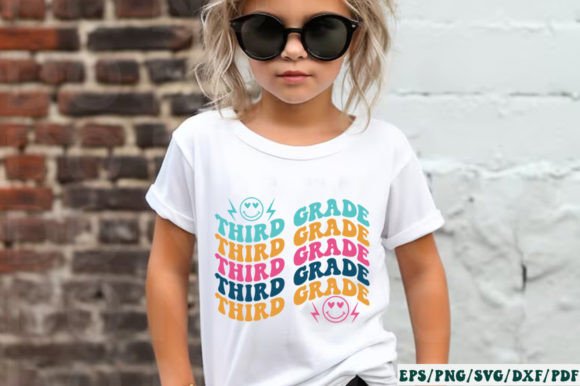
Third Grade Retro SVG is a focused, well-structured digital design bundle tailored for educators, small business owners, and makers who need classroom-ready or nostalgia-infused graphics—without sacrificing technical compatibility or production quality. Unlike broad “back-to school” collections that dilute relevance with generic motifs, this set centers on authentic retro aesthetics—think bold typefaces, mid-century color palettes, playful icons, and age-appropriate visual cues—that resonate specifically with third-grade learning environments and developmental milestones.
What You Actually Get—and Why Format Variety Matters
The bundle delivers five native file formats—SVG, DXF, PNG, EPS, and PDF—in a single zipped folder. That’s not just convenience; it’s workflow insurance. SVG files load natively into Cricut Design Space and Silhouette Designer Edition, supporting precise layering, resizing without pixelation, and clean cut lines for vinyl, iron-on, or paper crafts. DXF compatibility extends usability to Silhouette Basic Edition users—a practical detail often overlooked in education-focused bundles where budget constraints mean schools or teachers may rely on older software tiers.
EPS files open reliably in Adobe Illustrator, CorelDRAW, and Inkscape, making them suitable for print-ready lesson materials, editable posters, or custom worksheet integration. PNGs arrive at 300 DPI with transparent backgrounds—ideal for digital slides, Google Classroom headers, or Canva-based newsletters where clean compositing matters. PDFs serve as quick-printable flashcards, behavior charts, or parent handouts with consistent typography and spacing. Each format reflects intentional design decisions—not just export defaults.
Design Integrity Meets Real-World Use
Retro doesn’t mean dated. The Third Grade Retro SVG collection avoids clichéd clipart tropes by using cohesive line weights, balanced negative space, and intentional color blocking (e.g., mustard yellow paired with teal, not neon pink against lime green). Icons—like chalkboards, pencils, apples, and vintage-style numerals—are legible at both 1-inch and 12-inch scales, which matters whether you’re cutting tiny reward stickers or mounting large bulletin board letters.
Typography elements follow the same principle: fonts are either original vector-drawn lettering or carefully licensed retro-inspired faces—not distorted raster text masquerading as scalable art. That distinction becomes critical when scaling for laminated center signs or exporting to laser-cut wood trays. We tested several elements across Cricut Maker 3 and Silhouette Cameo 4—no unexpected node errors, no missing compound paths, and no embedded raster artifacts in the SVGs.
Who Benefits Most—and Where It Fits Naturally
Educators building themed literacy stations, math rotations, or classroom management systems will find immediate utility. A third-grade teacher preparing for a “Retro Reading Week” can use the SVGs to cut vinyl labels for book bins, generate printable comprehension cards in PDF, and drop PNG icons into interactive whiteboard activities—all from one source. No need to toggle between three different asset libraries or retrace outlines manually.
Small business owners running Etsy shops for educational printables benefit from the EPS and PDF variants. Those files integrate cleanly into Canva templates or Adobe InDesign layouts for professionally formatted workbooks, progress trackers, or seasonal activity packs—without licensing ambiguity or resolution compromises.
Hobbyists and homeschooling parents appreciate the plug-and-play reliability. If you're prepping a “Back to School” tote bag using your Brother ScanNCut Canvas software, the included SVG loads directly and cuts cleanly on cotton canvas or denim. No tracing, no flattening, no guesswork about stroke vs. fill settings.
Limitations Worth Noting—Not Dealbreakers
This isn’t an all-ages retro bundle. It intentionally omits preschool-level simplicity (e.g., oversized cartoon animals) and upper-elementary complexity (e.g., detailed science diagrams or multi-step project schematics). That focus is a strength—not a gap—if your work centers on third grade. Similarly, while the color palette leans warm and analog, it doesn’t include Pantone-matched swatches or CMYK-optimized separations. For most classroom or craft applications, RGB fidelity is sufficient; for commercial offset printing, minor color adjustment in Illustrator may be needed.
There are no animated versions, layered PSD files, or font files included—only the listed vector and raster formats. That keeps the download lightweight (under 8 MB unzipped) and avoids bloat, but means users needing motion graphics or typographic customization must source fonts separately.
Workflow Integration Beyond the Obvious
We used the Third Grade Retro SVG files across three distinct scenarios: first, generating reusable vinyl name tags for a summer camp program (Cricut + permanent vinyl); second, adapting PNG icons into editable Google Slides templates for remote phonics instruction; third, importing EPS assets into a self-published “Third Grade Math Journal” PDF using InDesign. In each case, the assets retained clarity, scaled predictably, and required minimal cleanup—no stray anchor points, no misaligned compound paths, no inconsistent stroke alignment.
One subtle but valuable feature: many SVGs include grouped layers labeled intuitively (“outline,” “shadow,” “fill”) rather than flattened objects. That allows users to toggle visibility, adjust opacity, or recolor individual components—useful when adapting a single design for differentiated instruction (e.g., high-contrast versions for students with visual processing needs).
A Balanced Assessment for Practical Users
Third Grade Retro SVG stands out not because it’s exhaustive, but because it’s curated. It respects the time constraints of educators juggling lesson planning, grading, and IEP documentation—and the technical boundaries of hobbyists who want reliable results without mastering vector editing. Its value lies in consistency across formats, attention to real-world sizing and legibility, and avoidance of trendy-but-fragile design choices (like ultra-thin strokes or excessive gradients that break in cut-file software).
If your projects involve third-grade curriculum support, classroom branding, or nostalgic-themed merchandise—even occasionally—the bundle delivers measurable efficiency gains. It won’t replace comprehensive design software, nor does it claim to. Instead, it functions like a well-organized supply closet: accessible, dependable, and purpose-built. For educators sourcing reusable assets, small business owners scaling printable offerings, or makers executing precise physical crafts, Third Grade Retro SVG earns its place as a repeat-use resource—not a one-off download.