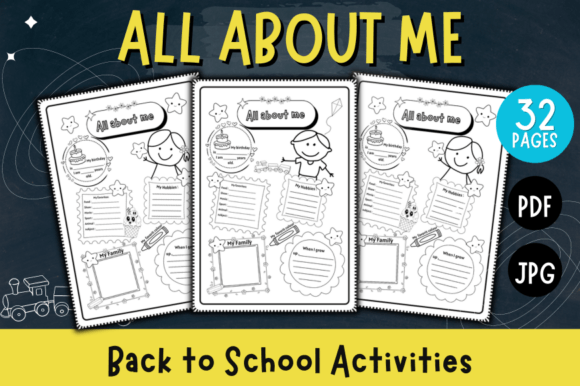
All About Me Selfie Activity
The All About Me Selfie Activity is a purpose-built, classroom-tested resource designed to support intentional relationship-building at the start of a learning year—or any time fresh connections matter. It’s not just a worksheet or icebreaker; it’s a structured yet flexible workflow tool that helps educators gather authentic, student-centered data while inviting voice, choice, and visual expression. Unlike generic “get-to-know-you” prompts, this activity integrates identity, reflection, and creativity into a single cohesive process—making it especially valuable for teachers prioritizing social-emotional learning, inclusive onboarding, and culturally responsive practice.
At its core, the activity asks students to take (or draw) a selfie-style representation of themselves, then layer it with curated personal details: favorite hobbies, family traditions, learning strengths, goals for the year, things that make them feel proud or calm, and even how they like to ask for help. The output isn’t graded—it’s collected, displayed, and referenced. That distinction matters: it shifts the focus from performance to presence, turning first-week logistics into meaningful orientation.
Where This Fits in Your Planning Workflow
Most educators begin back-to-school planning with curriculum mapping, supply lists, and schedule alignment. The All About Me Selfie Activity belongs in the *human infrastructure* layer of that plan—right alongside seating charts, communication protocols, and behavior-support frameworks. It’s not an add-on; it’s foundational scaffolding.
Think of it as parallel processing: while you’re finalizing lesson pacing guides, this activity runs in the background to inform your instructional decisions. The insights it surfaces—like which students express confidence through art versus writing, or who names quiet observation as their preferred way of engaging—feed directly into differentiation strategies, small-group planning, and even parent-teacher conference talking points.
It works best when scheduled early—but not first. Allow 1–2 days of low-stakes routines before launching. That gives students psychological safety and establishes your classroom as a space where reflection is valued, not rushed.
How It Integrates With Other Tools and Systems
The 32-page PDF includes editable fields, printable templates, and JPEG versions optimized for digital use—so it adapts cleanly to multiple delivery modes. You can use it:
- In hybrid classrooms: Assign the digital version via Google Classroom or Seesaw, then compile responses into a shared slideshow for virtual introductions.
- Alongside behavior systems: Reference student-submitted “things that help me reset” during calm-down conversations—not as a script, but as real-time evidence of self-awareness.
- With family engagement workflows: Share anonymized, permission-granted excerpts in your first newsletter (“Meet Maya—she’s teaching her little brother to tie shoes and wants to learn how plants grow!”). This builds trust before formal conferences begin.
- Within IEP or 504 planning: Use student-generated preferences (e.g., “I learn best when I can move,” “I like written instructions instead of spoken ones”) as primary-source input for accommodation discussions.
It also complements other ModernKids Learning Press resources intentionally. For example, pairing the All About Me Selfie Activity with the Pastel Classroom Decor set creates visual continuity—student selfies displayed beside soft-hued posters reinforce belonging. Or use the Alphabet Poster - Animal Theme to label a “Selfie Wall” by first letter of names, adding literacy reinforcement without extra prep.
Practical Implementation Tips for Real-Classroom Use
Success hinges less on perfection and more on consistency of intent. Here’s what experienced users report makes the biggest difference:
- Model it first. Complete your own “All About Me Selfie” live—showing your draft, crossing out ideas, adding a photo of your dog, explaining why “patience” is your word this year. Modeling vulnerability invites authenticity.
- Offer multiple entry points. Not every student will want to take a photo. Provide alternatives: a drawn portrait, a collage of symbols (music note + soccer ball + book), or even a “selfie in words” paragraph. The goal is self-representation—not technical execution.
- Build in reflection time—not just creation time. After submissions, spend 10 minutes asking: “What surprised you about someone else’s page?” or “Which detail feels most important to remember about Jamal?” This turns individual artifacts into collective understanding.
- Reuse intelligently. Store completed pages digitally (scanned or uploaded). Revisit them mid-year during goal check-ins or when reassigning groups. Ask: “Does this still reflect you? What would you change—and why?” That reinforces growth mindset and ownership.
Long-Term Usability and Quality Considerations
The file’s dual-format delivery (PDF + JPEG) supports both print fidelity and digital flexibility—critical for educators juggling district LMS requirements, accessibility tools, and evolving tech access. JPEGs allow quick resizing for interactive whiteboards or digital portfolios; the PDF maintains typography and layout integrity for printed displays.
Because the resource is marked for personal use only, it encourages thoughtful curation—not mass distribution. That limitation actually supports quality control: when you adapt or extend the activity (e.g., adding a QR code linking to a student’s Flip video introduction), those customizations stay aligned with your students’ actual needs—not generic standards.
One often-overlooked strength is its scalability. A kindergarten teacher might focus on “my favorite food” and “my family,” while a fifth-grade educator adds prompts like “a time I solved a problem” or “something I’m curious about.” The structure holds; the depth adjusts. That consistency reduces cognitive load during planning—no need to reinvent the wheel each year.
Why This Works Beyond the First Week
Many “first-day” activities fade after display. The All About Me Selfie Activity endures because it’s designed for iteration—not completion. Use it as a baseline for:
- Formative assessment calibration: Compare early self-descriptions (“I’m good at drawing”) with later work samples to spot emerging strengths.
- Transition support: When moving to a new grade or school, send a copy home for families to update over summer—creating continuity across years.
- Staff collaboration: Share anonymized themes (e.g., “68% of students named music as a comfort tool”) with specials teachers or counselors to align support strategies.
- Professional documentation: Include anonymized examples (with permission) in portfolio reflections on relationship-centered pedagogy—demonstrating E-E-A-T in action.
It doesn’t replace ongoing observation or conversation—but it sharpens both. When you already know that Aisha draws dragons to focus, or that Mateo names his older sister as his “learning helper,” your interventions land with greater precision. That’s not efficiency for efficiency’s sake. It’s respect, operationalized.
The All About Me Selfie Activity fits quietly but firmly into the rhythm of intentional teaching—not as a one-off event, but as a recurring touchpoint that reminds everyone: we see you, we remember you, and we’ll keep adapting to who you are becoming.