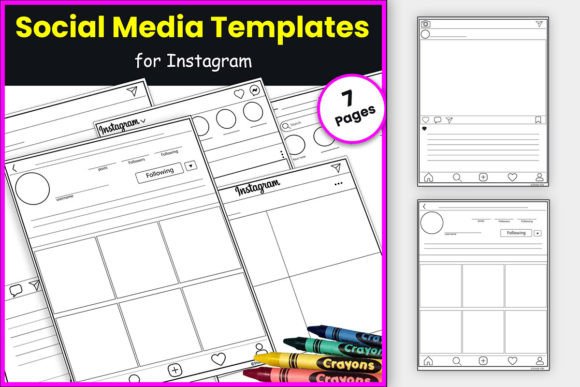
Social Media Templates for Classroom
Classroom instruction continues to evolve—not by abandoning foundational pedagogy, but by integrating tools and formats students already recognize, navigate, and respond to. Social Media Templates for Classroom is a practical, low-tech, high-impact resource that bridges the gap between digital literacy and curriculum-aligned learning. It’s not an app, platform, or subscription service. It’s a set of printable, editable PDF templates modeled after Instagram’s visual layout: clean borders, caption spaces, comment sections, profile headers, and even stylized “likes” and “hashtags.” What makes it distinctive isn’t novelty for its own sake—it’s how thoughtfully it supports real instructional goals across grade levels and subjects.
Designed for Clarity, Not Gimmicks
At first glance, these templates might appear decorative—just another classroom bulletin board prop. But their value emerges in consistent, repeatable use. Each template includes clearly labeled zones: a central image area (for drawing, pasting, or printing), a headline/profile bar (for names, roles, or historical figures), a caption field (for concise explanations or reflections), and a structured comment section (for peer feedback). The design avoids visual clutter while preserving enough social media familiarity to feel authentic to students. There are no forced filters, no simulated notifications, and no need for devices—making them equally viable in tech-limited schools or as offline extensions of digital assignments.
Flexible Integration Across Subjects and Ages
Unlike many “edtech” resources that lock users into one subject or grade band, Social Media Templates for Classroom scales meaningfully. In elementary classrooms, a third grader might illustrate a plant’s life cycle inside an “Instagram post,” labeling each stage in the caption and adding a playful hashtag like #RootedInScience. A middle school history class could recreate a 1963 March on Washington “post” from the perspective of a young participant—complete with a drawn photo, first-person caption, and peer comments reflecting historical empathy. High school literature students have used the templates to map character motivations across chapters, treating each major decision as a separate “post” in a fictional account—revealing narrative arc through visual chronology.
The resource includes multiple sizes (letter, half-page, and square-format PDFs), supporting varied display options: individual desk work, collaborative wall displays, or printed portfolios. Because they’re PDFs—not locked apps or web forms—they’re compatible with standard printers, document cameras, and LMS uploads. Teachers report minimal setup time: introduce the concept once, model one example, then assign variations based on current units.
What Works Well in Practice
Three strengths stand out in real classroom use:
- Low barrier, high ownership: Students invest more deeply when format feels familiar. Drawing a “selfie” for a back-to-school intro or designing a “bio” for a Civil War general lowers affective filters without sacrificing rigor.
- Structured peer interaction: The built-in comment section isn’t decorative—it scaffolds academic discourse. Instead of vague praise (“Cool pic!”), prompts guide responses: “What evidence supports your interpretation?” or “How does this connect to yesterday’s reading?”
- Cross-curricular consistency: Once students understand the template logic, they apply it across disciplines. A vocabulary term in science (photosynthesis) gets the same treatment as a literary device in English (foreshadowing)—reinforcing transferable analytical habits.
Realistic Considerations and Limitations
No resource replaces thoughtful lesson design—and these templates are no exception. Their effectiveness depends on intentional framing. Used as busywork or isolated activities, they risk becoming superficial. The strongest results occur when teachers align each template task with clear learning objectives: e.g., “Students will analyze cause-effect relationships in the Industrial Revolution by creating two contrasting ‘posts’—one from a factory owner’s profile, one from a child laborer’s—then compare captions and hashtags.”
Also worth noting: while the templates support differentiation (e.g., sentence starters in captions, optional hashtag banks), they don’t include built-in accessibility features like alt-text fields or screen-reader optimization. Educators supporting diverse learners may need to adapt the PDFs or supplement with verbal scaffolding or audio recording tools. And because they’re static PDFs—not interactive files—teachers seeking auto-graded responses or analytics will need complementary tools.
Who Benefits Most—and When
Educators who prioritize student voice, visual literacy, and low-prep differentiation tend to get the most sustained value from Social Media Templates for Classroom. They’re especially useful in settings where:
- Students need concrete ways to demonstrate conceptual understanding beyond essays or quizzes;
- Collaborative norms are being established, and structured peer feedback is still developing;
- Curriculum mandates cross-disciplinary connections (e.g., ELA + social studies, science + art);
- Classroom walls or digital portfolios serve as visible learning artifacts—making student thinking public and iterative.
Subject-area specialists also find utility: science teachers use them for lab reflection (“Post your hypothesis, method sketch, and unexpected result”); math educators ask students to visualize ratios, functions, or geometric proofs; world language instructors build “travel posts” from target-culture cities, embedding vocabulary and cultural notes organically.
Long-Term Utility Beyond the First Unit
Because the templates avoid dated trends (no TikTok-style effects or ephemeral story formats), they remain relevant year after year. Teachers report reusing core layouts across units—only changing instructions and rubrics. Some build “template libraries” where students select appropriate formats based on task type: a character analysis? Use the “Perspective Post.” Explaining a process? Try the “How-To Grid.” Over time, students begin recognizing patterns in academic communication itself—not just social media aesthetics.
One practical long-term benefit: these templates translate well to professional development contexts. Instructional coaches have used them in workshops to help teachers practice backward design—starting with a finished “student post,” then reverse-engineering the standards, questions, and scaffolds needed to get there. That dual-use—classroom tool and planning framework—adds quiet, lasting value.
A Grounded Recommendation
Social Media Templates for Classroom won’t transform teaching overnight—but it does offer something increasingly rare in educational resources: simplicity with intentionality. It respects teachers’ time, meets students where they are visually and culturally, and remains flexible enough to grow with evolving curricula. It’s not about making school look like social media. It’s about using a known structure to deepen thinking, clarify expression, and make learning visible—in ways that stick.