Rainbow Colored Pencils SVG Teacher PNG
When you're designing teacher-themed merchandise—whether for back-to-school apparel, classroom décor, or personalized gifts—the Rainbow Colored Pencils SVG Teacher PNG isn’t just decorative. It’s a functional asset that bridges creative intent with production-ready execution. This set includes scalable vector (SVG, EPS, DXF) and high-resolution raster (PNG) files—all at 300 dpi, with transparent backgrounds—designed specifically for real-world workflows across sublimation, heat transfer vinyl (HTV), permanent vinyl cutting, print-on-demand, cardmaking, and paper crafts.
How It Fits Into Your Creative Workflow
You don’t start with the file—you start with the need. A small business owner prepping a “Teacher Appreciation Week” collection. A school district staffer updating staff lounge signage. A freelance designer building a themed digital product bundle. In each case, the Rainbow Colored Pencils SVG Teacher PNG enters the process not as an afterthought, but as a precision tool: one that saves time on asset creation, ensures consistency across formats, and maintains fidelity whether scaled to fit a toddler’s t-shirt or a 24" wall decal.
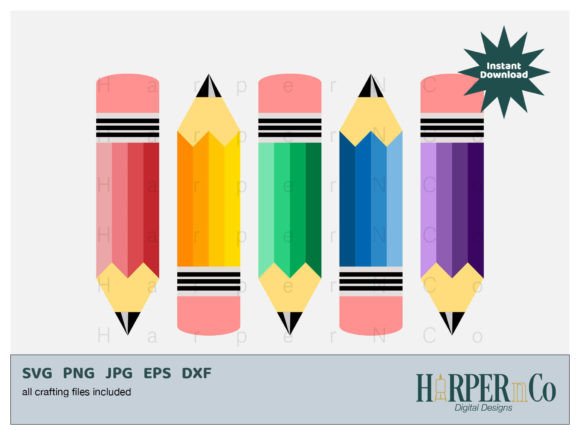
Before importing into Cricut Design Space or Silhouette Studio, consider your output method first. For sublimation on mugs or tote bags? Prioritize the PNGs—they’re optimized for color accuracy and edge clarity on light substrates. For HTV or permanent vinyl on tumblers or notebooks? Use the SVG or DXF versions—they retain clean cut paths and layer separation, letting you isolate pencil strokes, rainbow arcs, or text elements for multi-color layering.
Seamless Integration Across Platforms and Machines
The file package is built for interoperability—not lock-in. SVG works natively in Cricut Design Space, Silhouette Studio, and Glowforge Print & Cut. EPS opens cleanly in Adobe Illustrator, CorelDRAW, or Inkscape, allowing full recoloring, resizing, or repositioning without pixelation. DXF imports directly into laser cutters, CNC routers, and other industrial-grade machines—ideal if you’re producing wooden bookmarks, acrylic desk organizers, or engraved teaching tools.
No re-tracing. No manual cleanup. Each pencil stroke is a closed path; each rainbow band is a separate, editable shape. That means if you’re batch-producing teacher gift sets and need to swap “Ms. Johnson” for “Mr. Lee” on a series of mugs, you can ungroup the text layer in Illustrator, edit the name, and export updated PNGs in under 90 seconds—without touching the pencil illustration itself.
Practical Implementation Tips for Real Projects
For sublimation on apparel: Use the PNG version at actual print size (e.g., 10" wide for a front-chest design). Its transparent background eliminates white halos around pencil tips or rainbow curves—critical for crisp results on polyester blends. Pair it with a simple serif font for “World’s Best Teacher” and align both elements using guides in Canva or Photoshop before exporting the final print file.
For layered vinyl decals: Import the SVG into Silhouette Studio and use the “Release Compound Path” function to separate individual pencils or color bands. Assign different colors to each layer—red pencil on red HTV, yellow pencil on yellow HTV—and use registration marks for precise alignment during weeding and application.
For printable cards or stationery: Drop the PNG into a layout tool like Affinity Publisher or Microsoft Word. Because it’s 300 dpi and transparent, it sits cleanly over watercolor textures, kraft paper backgrounds, or subtle grid lines—no need for clipping masks or background erasing.
Quality Control Starts Before You Cut or Print
Always preview at 100% zoom before sending to your machine. Check for stray anchor points (especially where rainbow bands meet pencil erasers), overlapping paths, or unintended groupings. Most issues arise not from the file itself—but from how software interprets embedded layers during import. If you’re using older versions of Silhouette Studio or Cricut Design Space, open the EPS in Illustrator first, simplify paths via Object > Path > Simplify, then re-export as SVG with “Responsive” unchecked to preserve stroke weight integrity.
Test one file on scrap material before committing to a full run. Sublimation requires exact time/temperature/pressure calibration—especially with rainbow gradients that can shift toward magenta or cyan if the press runs hot. Vinyl projects demand accurate blade depth and pressure settings; the clean vector outlines in the DXF version help your machine recognize true edges versus anti-aliased fuzz.
Long-Term Usability and Asset Management
Treat this file set like reusable infrastructure—not disposable clipart. Store the original ZIP in a clearly labeled cloud folder (e.g., “Design Assets > Education > Rainbow Pencils”). Inside, keep subfolders for “SVG – Ready to Cut,” “PNG – Sublimation Ready,” “EPS – Editable Master,” and “DXF – Laser Ready.” Name each file with its primary use: RainbowPencils_Teacher_SVG_Cricut_v2.svg, not “image123.svg.”
Version control matters. If you modify the EPS to add a chalkboard texture behind the pencils, save it as RainbowPencils_Teacher_EPS_Chalk_v1.ai. That way, you retain the clean original for future sublimation jobs while keeping custom variants organized and searchable.
Where It Adds Value Beyond Aesthetics
This isn’t about adding color—it’s about signaling intention. Rainbow-colored pencils evoke creativity, inclusivity, and joyful learning. When used on a teacher’s coffee mug, it communicates appreciation *and* recognition of their role in nurturing diverse thinking. On a classroom door sign, it subtly reinforces a safe, expressive environment. On a student-made thank-you card, it gives kids a polished, professional-looking element they didn’t have to draw by hand.
That resonance multiplies when the asset scales across touchpoints. One SVG becomes a T-shirt graphic, a matching Instagram Story highlight icon, a printable reward certificate, and a die-cut foam board display—all from the same source file. Consistency builds trust. Efficiency frees up mental bandwidth for lesson planning, client revisions, or inventory management.
Compatibility Notes Worth Keeping Handy
- Cricut users: The SVG imports with grouped layers intact. Ungroup once to access individual pencils or rainbow segments. Avoid “flatten” unless preparing for Print Then Cut.
- Silhouette Cameo users: DXF files load faster than SVG for complex cuts. Use the “Trace” function only if editing raster elements—this set doesn’t require it.
- Glowforge users: Upload the SVG and assign “Cut” to outlines, “Score” to inner pencil lines, and “Engrave” to subtle texture overlays (if included in your version).
- Sublimation printers: PNGs embed no ICC profiles by default—assign sRGB IEC61966-2.1 in Photoshop or Affinity Photo before printing to avoid oversaturation.
Watermarks are removed upon download—no extra steps, no hidden layers. What you receive is production-ready. That reliability lets you move from concept to customer without detours: sketch the idea, select the file, adapt it to your medium, test, refine, and ship. No guesswork. No rework. Just clarity, consistency, and color—exactly where you need it.